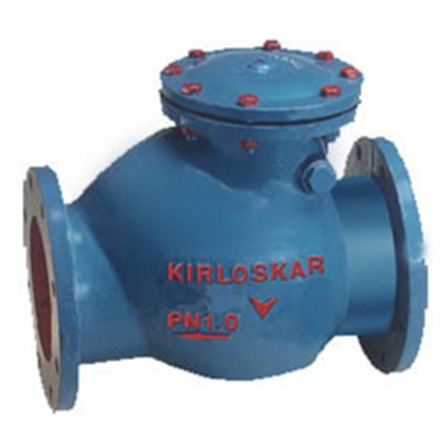
Products
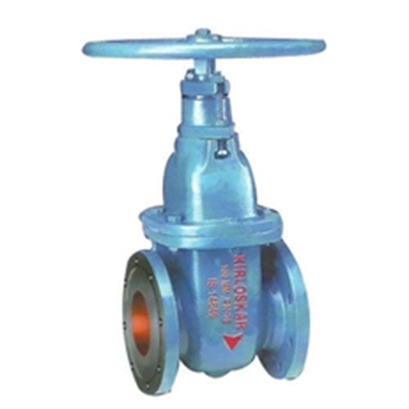
Kirloskar Cast Iron Non-Rising Spindle Sluice Valves (Gate Valves) are heavily utilized pipeline mechanisms specifically designed for space-restricted environments where vertical clearance is limited. Manufactured by Kirloskar Brothers Limited (KBL) under strict quality controls, the internal thread of the wedge engages with the stem threads to raise or lower the gate inside the body—ensuring the spindle itself does not move vertically during operation.
These valves are primarily deployed in municipal water distribution, fire-fighting systems, water treatment plants, and industrial waterworks networks.
Core
- Design & Manufacturing Standards: Manufactured strictly in accordance with IS 14846 (Indian Standard) or BS 5163 (British Standard).
- Size Spectrum: Broad dimensions ranging from standard 50 mm up to large-scale 1500 mm pipelines.
- Pressure Ratings: Extensively supplied in PN 1.0 (10 kg/cm²) and PN 1.6 (16 kg/cm²) classes.
- Media Capabilities: Ideal for managing clear water up to 45°C containing up to 5000 ppm turbidity levels.
- Material of Construction (MOC):
- Body, Bonnet & Wedge: Cast Iron (CI) conforming to IS 210 Gr. FG 260.
- Spindle / Shaft: High-tensile Stainless Steel SS410 or rigid Bronze.
- Seating & Wedge Rings: High-grade Bronze (IS 318 Gr. LTB-2) providing highly reliable leak-tightness over thousands of cycles.
- End Connections: Double-flanged flat face (FF Flanged) drilling per IS 1538 Tbl 4 & 6 standards.
Key
- Compact Installation Footprint: Because the stem moves internally without rising above the handwheel, it operates smoothly inside shallow underground trenches, tunnels, or tight ceiling spaces.
- Low Pressure Drop: Designed with straightforward full-bore fluid passages ensuring minimal resistance and negligible friction losses during fully opened flow.
- High Endurability: Precision-machined bronze seats resist local erosion, scaling, and general pipeline corrosion.